
Welcome to the Wild Medic
We Provide Extreme Medicine & Mindset Training.
So you will never feel un-prepared again.
What We Do:
We help people in high stakes environments optimise their mindset, beat stress & build resilient teams.
Whether you're wanting to up level your company, career or crew, ensuring the safety and well-being of your participants is paramount.
Why Choose Us?
Experts in Extreme Medicine, Mental Health & Mindset Training for Remote, Luxury, High Stakes Environments.
Running a luxury, high stakes outfit can be overwhelming. You need more than just the best itinerary and stunning locations. You need to be prepared for any situation.
We can provide you with Coaching, Courses & Workshops (Live & Online) which equip you with the knowledge and tools to handle emergencies. You will also learn how to manage: Risks, mental health, mindset & people.
And most of all provide an unforgettable experience for your clients.
We also provide Team Building & Equine Assisted Leadership for developing communication within teams, trust & empathy. Essential skills required for every moderns day leadership role.
The Wild Medic essentially covers all aspects of Wilderness Medicine including Marine medicine.
We also have a bespoke section for Superyacht & High Performance Race Yachts. It is called The Yacht Medic.
Whether you prefer to be out in the wild, or at sea, you will LOVE the Adventure Ready Program.
Our signature offer is the Adventure Ready Program, designed specifically for those who are passionate about creating safe, successful, and unforgettable adventures, retreats, and events.
Our clients are typically yacht captains, pilots, expedition leader & doctors, event/retreat facilitators, luxury tour operators, personal trainers, teachers & parents.
This program, delivered on line & in person, is tailored to equip you with the essential skills and knowledge needed to navigate the complexities of planning and executing exceptional experiences.
Course Objectives
Throughout this course, you will:
- Learn to conduct thorough risk assessments and develop robust emergency management plans.
- Build resilience in yourself and your team to handle stressful situations effectively.
- Master psychological first aid to support participants and staff during crises.
- Embrace different leadership styles to inspire and guide your team.
- Understand human behavior in extreme conditions and lead your team from fear to flow.

The Ultimate Leadership Checklist- Our Free Gift to Fast Track Your Preparedness
Ultimate Leadership Checklist is your go-to resource for ensuring every detail is covered.
Comprehensive Planning Guide
Step-by-step instructions to help you plan from start to finish.
Emergency Management Plan
Detailed procedures to handle any crisis effectively.
Risk
Assessment
Identify potential risks and outline mitigation strategies.
Psychological First Aid
Train in recognizing distress signs, provide trauma support, and conduct effective debriefings.
Team
Building
Fun and engaging exercises to strengthen your team. Plus, effective Communication Tips.
Medical Preparedness
Stock a complete First Aid Kit, ensure specialized supplies, and maintain staff certification
Blog
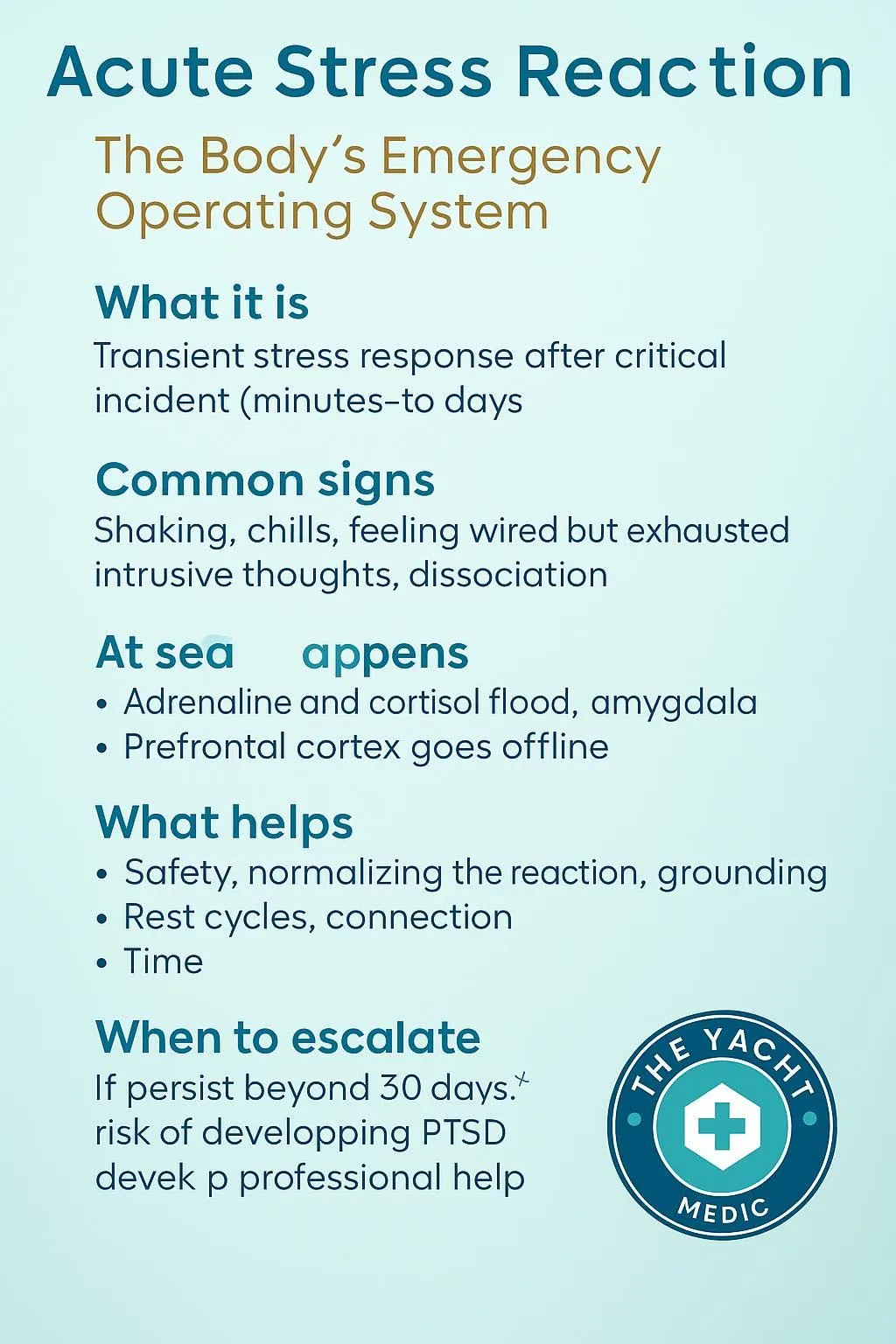
What Is Acute Stress Reaction?
What Is Acute Stress Reaction?
The World Health Organization defines Acute Stress Reaction (ASR) as a transient response to exceptional stress, arising within minutes to hours and usually resolving within days.
Acute Stress Disorder (ASD) is for symptoms lasting from 3 to 30 days. If symptoms persist beyond a month, the diagnosis shifts to Post-Traumatic Stress Disorder (PTSD).
Think of ASR as the body’s “emergency operating system.” It mobilises everything to keep you alive — even after the danger has passed.
.
.
What Happens in the Body
• Adrenaline & noradrenaline flood — heart rate spikes, muscles tremble, pupils dilate.
• Cortisol release — fuels energy, keeps you hyper-alert.
• Blood shunting — away from skin and gut to heart, lungs, and muscles (cold, clammy hands).
• Autonomic chaos — sympathetic system hits the accelerator; parasympathetic can’t find the brake.
Neurologically, the amygdala (threat detector) hijacks the system, while the prefrontal cortex (logic, planning) goes offline. You’re in survival mode, not reasoning mode.
.
.
At Sea: What It Looks Like:
• The stewardess who can’t stop shaking hours after the resuscitation attempt.
• The deckhand pacing the dock at 3am, replaying every second of a MOB.
• The captain who bursts into tears in the wheelhouse after holding it together for the crew.
Common signs:
• Shaking, chills, cold skin
• Palpitations, dizziness, breathlessness
• Hypervigilance, restlessness
• Emotional swings: tearful, irritable, numb
• Transient dissociation: feeling detached or unreal, as if watching events from outside the body
• Intrusive memories or flashbacks
• Insomnia or bone-deep exhaustion
.
.
What Helps (Psychological First Aid)
1. Safety first. Create physical and psychological safety — quiet space, warmth, hydration, food.
2. Normalize it. Say the words: “This is an acute stress reaction. It’s the body’s survival mode. You’re not broken.”
3. Ground the body. Box breathing, prayer, orienting techniques (naming five things you see, hear, feel). Walk barefoot on deck or shore.
4. Short recovery cycles. Even 20-minute naps or rest periods help reset the system.
5. Connection. Talk, debrief, sit with someone. Trauma thrives in silence.
6. Time. Most reactions fade in days. If symptoms persist beyond 3 days but less than 30 → this may be Acute Stress Disorder (DSM). Beyond 30 days → seek professional help for possible PTSD.
.
.
Leadership at Sea
Captains, officers, medics — you will see acute stress reaction in your crew, and often in yourselves.
Your role isn’t to snap anyone out of it. It’s to recognize it, name it, normalize it, and support recovery.
One simple sentence can change everything:
“Shaking, crying, feeling wired or numb — this is a normal acute stress reaction. Let’s get you warm, fed, and grounded.”
That moment prevents shame — and can stop a transient stress reaction from embedding into long-term trauma.
.
.
Acute Stress Reaction is the storm inside after the storm outside. It’s your body’s way of saying: you are alive — now survive.
Because resilience at sea isn’t about being unshaken.
It’s about knowing what happens when you are — and how to come back stronger.
References
• World Health Organization. (2019). International Classification of Diseases, 11th Revision (ICD-11).https://icd.who.int/
• American Psychiatric Association. (2013). Diagnostic and Statistical Manual of Mental Disorders (5th ed.).Arlington, VA: American Psychiatric Publishing.
• Bryant, R. A. (2010). Acute stress disorder as a predictor of posttraumatic stress disorder: A systematic review. Journal of Clinical Psychiatry, 71(2), 230–239.https://doi.org/10.4088/JCP.09r05072blu
• McFarlane, A. C. (2010). The long-term costs of traumatic stress: Intertwined physical and psychological consequences. World Psychiatry, 9(1), 3–10.https://doi.org/10.1002/j.2051-5545.2010.tb00254.x
• Everly, G. S., & Flynn, B. W. (2006). Principles and practical procedures for acute psychological first aid. International Journal of Emergency Mental Health, 8(2), 93–100.

Founder of the Wild Medic
Manda J Beaver
(Amanda Jean Hewson Beaver RN)
Manda combines nursing, emergency medicine, and international public health to support leaders in yachting, retreats, and expeditions. She has trained thousands, including Olympic teams, focusing on marine and remote medicine. Manda's approach integrates practical skills, resilience, and leadership coaching to ensure clients are ready for any challenge in the wild or at sea.